The Best Thing That Ever Left Town: How Small-Town Rejection Became America's Secret Fuel

Photo: Mack Sennett Comedies / Associated First National, Public domain, via Wikimedia Commons
The Best Thing That Ever Left Town: How Small-Town Rejection Became America's Secret Fuel
There's a specific kind of humiliation that only a small town can deliver. It's not the anonymous cruelty of a city, where you can disappear into the crowd and reinvent yourself before sundown. Small-town rejection is intimate. It has a face. It has a name. It remembers you at the gas station and at the diner and at every family reunion for the next thirty years.
And yet — and this is the part that keeps showing up in American history — that particular wound has produced an extraordinary number of the country's most defiant, most consequential, most enduring icons.
This isn't a coincidence. It's a pattern. And it says something important about how greatness actually gets made.
The Mechanics of Small-Town Dismissal
Before we get to the stories, it's worth understanding what small-town rejection actually does to a person — because the mechanism matters.
In a small community, your identity is largely assigned to you by consensus. People decide who you are early, and those decisions tend to stick. The kid who's considered odd, or too ambitious, or not quite right in some way that the community can't fully articulate — that kid gets a label. And labels in small towns have a way of becoming load-bearing walls. They hold the social structure up. Challenging them isn't just personally uncomfortable; it's socially disruptive.
So when someone refuses the label — when they insist, against all available evidence from their immediate environment, that they are something other than what the town has decided — the community often responds with the tools it has available: mockery, exclusion, low expectations delivered with great confidence.
What that response does, in the right person, is clarify everything. It removes ambiguity. It makes the choice simple: accept the ceiling or leave and build something that makes the ceiling irrelevant.
America's most defiant icons, with remarkable frequency, chose the second option.
Johnny Cash and the Gospel of the Outcast
Johnny Cash grew up in Dyess, Arkansas — a Depression-era agricultural community built by the federal government as a resettlement project for displaced farm families. It was a place of genuine hardship and genuine community, but it was also a place with a very clear sense of what a person was supposed to be and how they were supposed to behave.
 Photo: Johnny Cash, via www.rollingstone.it
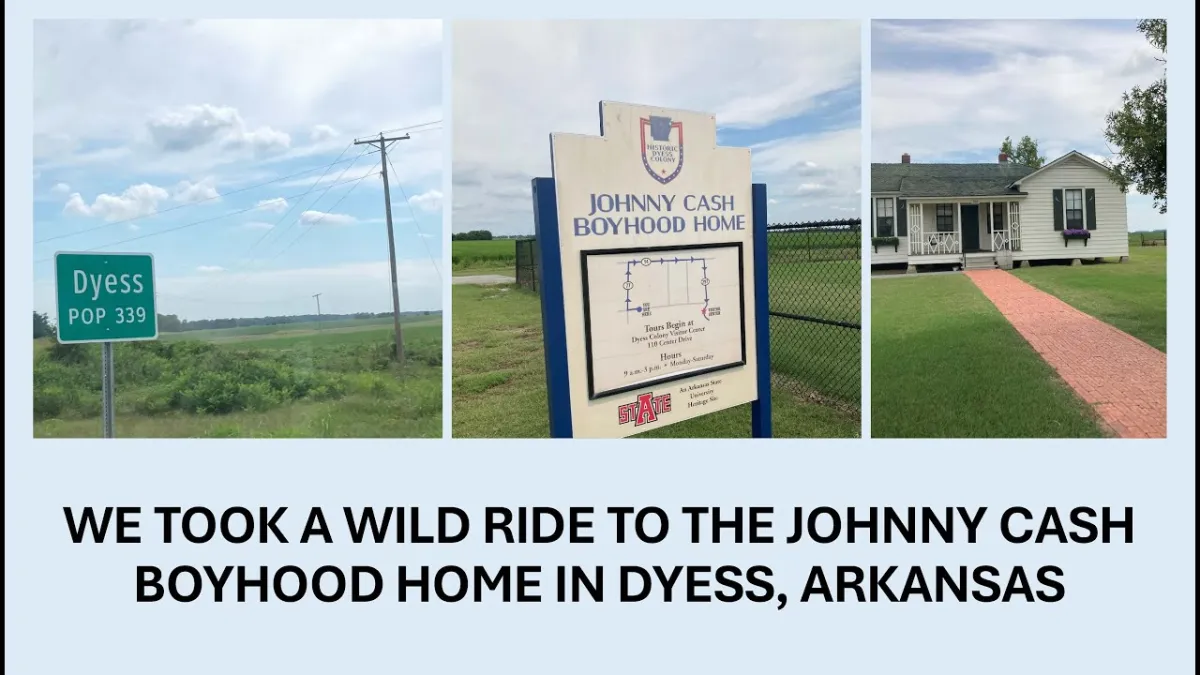 Photo: Dyess, Arkansas, via i.ytimg.com
Cash was strange by Dyess standards. He had a voice that didn't fit, ambitions that didn't fit, a darkness inside him that the community's social framework had no category for. He left as soon as he could — Air Force, then Memphis, then Sam Phillips and Sun Records and a career that would eventually make him one of the most recognized artists in American history.
But the Dyess years didn't leave him. They showed up in every song about prisoners and outcasts and people the respectable world had decided to forget. Cash's entire artistic identity was shaped by the experience of being the person who didn't quite belong — and his genius was turning that experience into something that resonated with millions of people who felt exactly the same way in their own small towns, their own small worlds.
The community that couldn't figure out what to do with him produced the man who gave a voice to everyone else who'd ever been figured wrong.
Sinclair Lewis and the Revenge of the Bookish Kid
Sinclair Lewis grew up in Sauk Centre, Minnesota — a small prairie town that would have been entirely unremarkable in American history if Lewis hadn't grown up to write Main Street, the 1920 novel that skewered small-town American life with such precision that it became a national sensation and, eventually, part of the case for awarding Lewis the Nobel Prize in Literature.
 Photo: Sinclair Lewis, via rapleys.com
Main Street is, among other things, an act of literary revenge. Lewis had been the awkward, bookish, socially clumsy kid in Sauk Centre — the one who read too much and fit in too little, who wanted things the town couldn't provide and couldn't understand why he wanted them. The town, in return, gave him the kind of low-grade, persistent social friction that marks a person for life.
He left. He wrote. And when Main Street came out, readers across America recognized their own towns in its pages — the gossip, the conformity pressure, the quiet violence of being told that wanting more than what's here makes you a problem.
Sauk Centre eventually named a street after him. The town that had made him miserable spent the rest of the century claiming him as its own. Lewis, to his credit, found this about as funny as you'd expect.
The Pattern in the Music
Country music — and rock and roll, and blues, and virtually every distinctly American musical form — is substantially built on the experience of small-town exile. The artists who created these genres were, with striking regularity, people who had been marked as wrong by the communities that raised them.
Buddy Holly in Lubbock, Texas. Elvis Presley in Tupelo, Mississippi. Loretta Lynn in Butcher Hollow, Kentucky. These weren't people who were celebrated by their hometowns on the way up. They were people who left because staying meant accepting a version of themselves that didn't fit, and who turned the energy of that non-fitting into something the whole country eventually wanted to listen to.
The music they made carried the specific emotional signature of people who had been underestimated by people who knew them personally — which is a different and more potent kind of underestimation than the abstract dismissal of strangers. It has a specificity to it. A heat. And that heat, channeled through a guitar or a piano or a voice, is exactly what makes the music feel like it's talking directly to you.
The Political Dimension
The small-town-rejection-to-national-prominence pipeline isn't limited to the arts. American political history is littered with figures who were first dismissed by the communities that produced them.
Lyndon Johnson, who grew up in the Hill Country of Texas in circumstances of genuine rural poverty, was considered by many of his neighbors to be too hungry, too pushy, too nakedly ambitious for the social norms of the region. He left, went to Washington, and eventually accumulated more legislative power than almost any figure in American political history — power he used, in part, to pass legislation designed to help the rural poor he'd grown up among.
The psychology of that trajectory is worth sitting with. The ambition that made him uncomfortable in Johnson City, Texas, became the engine of one of the most consequential political careers of the 20th century. The community that had found him too much became, in a sense, the fuel he burned for decades.
What the Pattern Actually Tells Us
It would be easy to read these stories as simple vindication narratives — the misfit goes away, becomes famous, comes home to collect their honorary degree. But that framing misses something important.
The small-town rejection that launched these careers wasn't incidental. It was generative. It created a specific kind of clarity about identity — a forced answer to the question of who you are when the community around you has already decided you're not quite right. The people who thrived after that experience didn't just escape their hometowns. They carried those hometowns with them, processed them, and turned the friction into fuel.
America has always been a country that celebrates the self-made individual. What it talks about less is the social machinery that makes self-making necessary — the communities that push people out, often without meaning to, and in doing so, accidentally send them toward the very experiences that define them.
Every small town that ever wrote someone off was, in its own way, making a contribution to American culture it will never fully understand or take credit for.
The best thing some of those towns ever did was make someone feel like they had to leave.