One Cart, No English, No Ceiling: The Street Vendor Who Taught America to Dream Without Limits
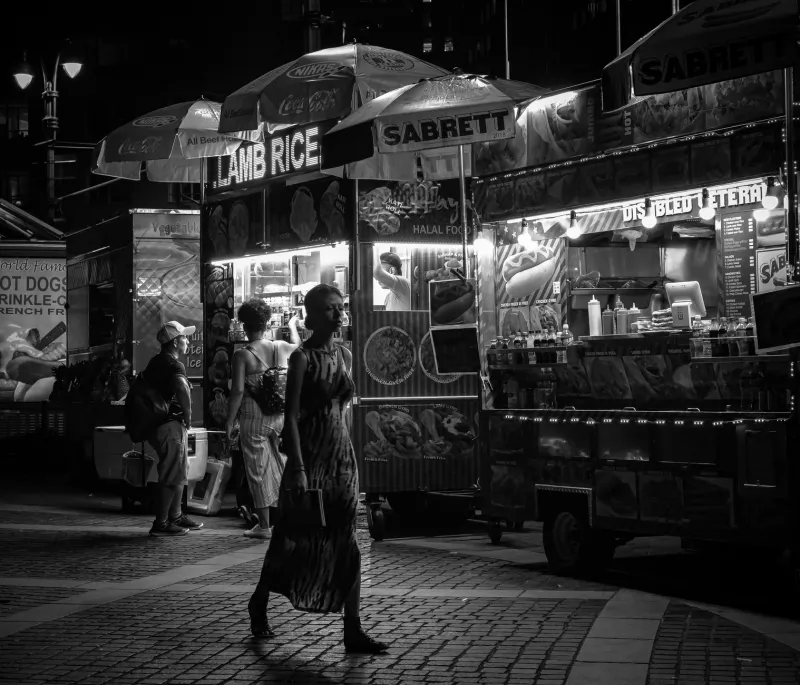
New York City at the turn of the twentieth century was a place of extraordinary noise. The streets of the Lower East Side were dense with bodies, languages, and competing ambitions — a neighborhood where the distance between poverty and possibility felt simultaneously vast and razor-thin. Into this world, in the late 1880s, stepped a young man named Hyman Schoolman.
He had come from a small town in Eastern Europe with almost nothing. His English consisted of a handful of words. His savings, after the crossing, amounted to less than most New Yorkers spent in a week. What he did have was a pushcart, a borrowed stock of dry goods, and an attention to the people around him that would turn out to be worth considerably more than any formal business education.
Reading the Street Before He Could Read the Signs
The pushcart economy of turn-of-the-century New York was enormous, chaotic, and almost entirely invisible to the city's more established commercial class. Hundreds of vendors worked the same blocks, selling the same goods, competing on margins so thin they barely existed. Survival required either luck or insight, and Schoolman had learned early that luck was not something you could plan around.
What he noticed, working his route through the tenement blocks, was something that the fixed-store merchants uptown hadn't bothered to consider: his customers weren't just buying goods. They were buying familiarity. They were buying the comfort of being spoken to in a language they understood, of being sold to by someone who shared their context, who knew without being told that a family of six was feeding itself on a budget that most Americans wouldn't recognize as a budget at all.
Schoolman started adjusting his inventory not to what the wholesale market was offering at the best price, but to what the women on his block actually needed on a Tuesday morning in February. Smaller quantities. Specific items. Things that fit the rhythms of households he understood because he lived inside one himself.
His sales grew. Not explosively — nothing about this life was explosive. But steadily, in the way that real things tend to grow when they're built on something true.
The Language Nobody Taught Him to Leverage
His English remained limited for years. This was, by any conventional measure, a serious professional liability. Business in America was conducted in English. Contracts were written in English. Banks operated in English. The entire formal economy through which a person might scale a small operation into something larger was, linguistically speaking, a locked room.
But Schoolman's customers didn't speak much English either. And the merchants and suppliers who served immigrant communities — who understood that this market existed and had real purchasing power — were often more willing to work across language barriers than their uptown counterparts. He built relationships with other immigrant vendors and small wholesalers, creating a supply network that ran largely on trust and reciprocity rather than formal contracts.
His outsider status, which looked from the outside like pure disadvantage, had given him access to a parallel economy that more established merchants had largely overlooked. He wasn't competing with the department stores on Fifth Avenue. He was serving a customer those stores had never tried to reach.
The Moment the Cart Became a Store
By the early 1900s, Schoolman had saved enough to rent a small storefront on Orchard Street. The transition from cart to counter was significant not just practically but symbolically — it was the moment the informal economy delivered him to the formal one.
He brought with him everything the cart had taught him. He knew his customers by name. He extended credit to families he trusted, in the informal way that immigrant communities had always operated when banks were either inaccessible or simply unwilling. He stocked his shelves based on observation rather than trend reports, because trend reports were written for a different America than the one he served.
The store grew. He expanded. He brought family members over from Europe, building both a business and a community around it. His children grew up speaking fluent English and eventually helped him navigate the formal business structures that had once been entirely closed to him.
What he had built was not just a retail operation. It was a model — a demonstration that the immigrant street economy was not a waiting room for the real economy, but a legitimate, functional, and often more responsive version of it.
The Advantage of Seeing Fresh
There is something that happens when you arrive in a place without the accumulated assumptions of people who have always lived there. You look at a street corner and you don't see what's already there — you see what's missing. You look at a community and you don't see a demographic category — you see specific people with specific needs that are currently going unmet.
This is the immigrant entrepreneur's particular form of vision, and it has shaped American commerce in ways that are often acknowledged in retrospect but rarely appreciated in real time. The people who built the garment industry in New York, the produce markets in California, the restaurant culture of virtually every major American city — they were often people who arrived without much and saw, with fresh eyes, exactly what the market had left on the table.
Schoolman saw it from a pushcart. He saw it in a language he was still learning. He saw it while people around him were confident there was nothing worth seeing.
What He Left Behind
Hyman Schoolman is not a household name. His story didn't make the newspapers of his era, and it hasn't been the subject of the kind of retrospective attention that gets bestowed on the Carnegies and Rockefellers of American business history. He was one of thousands of immigrant vendors who built their lives from the street up, and his particular version of that story has largely been carried forward in family memory rather than public record.
But the blueprint he followed — arrive with nothing, watch carefully, serve the people others ignore, build slowly and honestly, let the margins grow with the trust — is one that has been replicated by immigrant entrepreneurs across every era of American life. It shows up in the Korean-owned grocery stores that kept New York fed during the 1970s fiscal crisis. It shows up in the Vietnamese-owned nail salons that built an entire industry from a single community college program. It shows up in the Mexican-owned food trucks that turned street food from a poverty marker into a cultural institution.
The pushcart was never just a pushcart. It was always the beginning of something the city hadn't yet imagined.
And the people pushing it were never just vendors. They were, in the most literal sense possible, the original American dreamers — the ones who showed up before the dream had a name and started building it anyway.